Vampire-blood medication
My Vampire Love (Completed)Vampire-blood medication is the central medical and biological mechanism through which Jenifer Kate Lawrence survives aplastic anemia and becomes the living subject of the pure-blood experiment. The tiny brown pills appear to be ordinary treatment, but they are a diluted, weakened form of Eric Wilson’s blood. They make blood cells for a body that cannot produce red blood cells, white blood cells, or platelets, while also carrying vampire cells that may eventually awaken. What begins as life-preserving medication is thus revealed as both therapy and a controlled process of transformation.
Definition and Medical Function
Vampire-blood medication is necessary because Jenifer’s severe aplastic anemia prevents her bone marrow from producing any type of blood cell. Without the pills, she could die from an ordinary infection such as the flu or bleed to death from a wound that would not normally be fatal. Her physical weakness, fainting, vomiting, and unexplained nosebleeds are not treated in the narrative as minor symptoms; they are signs of a body whose basic blood-making function has failed.
The medication allows Jenifer to live an apparently ordinary human life. She describes the pills as small and brown, and their continued use prevents her body from shutting down. When she stops taking them, she understands that only a few days may separate refusal from being confined to bed and then death. That knowledge makes the medicine both indispensable and coercive: survival depends on swallowing something whose true nature she has not been allowed to know.
The medication also establishes a distinction between the weaker blood she has been consuming and the much larger transfusion later given by Katalin. Katalin’s dose is described as almost thirty times the amount Jenifer is accustomed to receiving. That stronger exposure intensifies her emotions and fuels and strengthens the body, making clear that dosage and frequency determine whether vampire blood merely heals, produces a made vampire, induces a coma, creates a zombie-like condition, or supports the development of a pure-blood state.
Concealed Origin and Operation
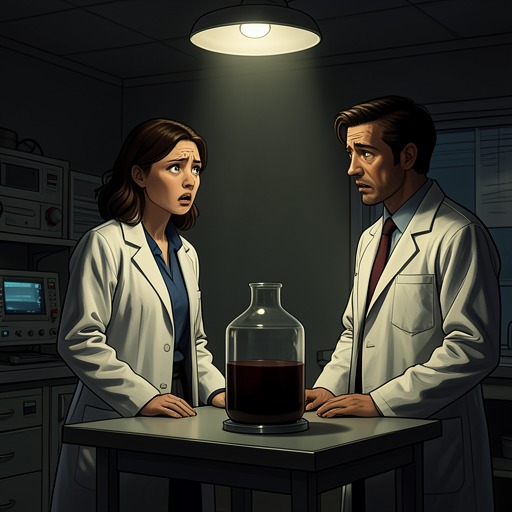
Eric eventually explains that the pills are really his blood, confined to a smaller and weaker state. In that form, the blood is powerful enough to heal Jenifer and keep her alive but not yet powerful enough to change her fully. The medication therefore functions as a controlled delivery system: it replaces the blood cells her body cannot make while gradually introducing vampire material into her bloodstream.
The revelation changes the meaning of Jenifer’s entire medical history. Eric’s blood has been entering her body every day, and she realizes that it has been keeping her alive all her life. The treatment is not an impersonal pharmaceutical intervention but an invisible bodily connection to Eric. His blood has been continuously healing her without her informed understanding, making care inseparable from secrecy and dependence.
The medication’s immediate effect is restorative rather than openly supernatural. It enables Jenifer to make blood cells, but Eric clarifies that the cells she produces are not entirely human. The pills have therefore altered the foundation of her body before any visible awakening occurs. Jenifer remains outwardly close to an ordinary human while her internal biology increasingly belongs to a mixed and developing state.
The Experiment Behind the Treatment
The medicine is part of a wider vampire project designed to preserve vampire dominance. Eric explains that vampires currently rule the supernatural order because of the strength and scarcity of pure-blood vampires, although witches once held control and power could shift to shifters or other supernatural species. The experiment seeks to create more pure-blood vampires so that vampires will remain at the top of that hierarchy.
Earlier attempts failed. Humans exposed to the process died or became something other than the intended result. Too much vampire blood given too often produces a made vampire; too little can lead to a coma or a zombie-like state. Experiments involving pregnant mothers also failed: injecting fetuses with vampire blood or transfusing mothers during the first three months of pregnancy produced hybrids rather than true pure-blood descendants.
Katalin’s decisive idea was to use a child whose body could not make blood cells. Such a child could be supplied with vampire blood and would then create vampire blood cells internally. The pills are the practical expression of that theory. Jenifer’s illness makes her body uniquely useful to the experiment because the vampire blood does not merely circulate alongside a functioning human blood system; it supplies the material her body lacks and gradually becomes part of the system that sustains her.
Jenifer is identified as the first living subject of this kind. Her condition makes her simultaneously endangered and protected: she is vulnerable because rival supernatural groups want her dead, but she is guarded because her survival may prove that a human can awaken as a true pure-blood vampire. Her body is consequently treated as a strategic resource rather than solely as a person with a chronic illness.
Awakening, Marriage, and Political Consequences
The medication prepares Jenifer for the age at which pure-blood vampires awaken. Eric explains that vampire blood remains dormant before eighteen and then awakens, making the individual stronger and faster. Jenifer understands that the same process is expected to happen to her. The medicine has therefore postponed visible transformation while making future awakening possible.
This expectation also explains the pressure surrounding Jenifer’s marriage to Eric. She realizes that the marriage must occur before she turns eighteen because her awakening will make her a vampire as well. Eric further connects her blood and his own to the possibility of a child who would be an exceptionally pure and powerful pure-blood. The treatment thus extends beyond individual survival into reproduction, inheritance, and species politics.
The medication exposes a form of medicalized power. Jenifer is treated, measured, protected, and prepared according to the interests of a ruling species. Her aplastic anemia is not only a disease requiring care; within the vampire system, it is the condition that makes her suitable for experimentation. The language of healing therefore conceals a process that converts her body into evidence, technology, and potential breeding material. Eric insists that she is someone rather than something, but that reassurance appears precisely because the surrounding system repeatedly reduces her to what her body might produce.
Refusal, Crisis, and Narrative Significance
Jenifer’s refusal to take the pills is both a medical crisis and an act of resistance. In the bathroom, she removes three pills from the bottle, stares at them while struggling with doubt, drops them into the toilet, and flushes them after they dissolve into faint pinkish-red water. She then returns to Eric and lies that she is fine. The scene gives the medicine a visible material form: what seemed like harmless brown tablets becomes unmistakably connected to blood, secrecy, and the power to decide what enters her body.
The consequences are immediate. Jenifer knows that her body is beginning to shut down, and she considers death an escape from pain, guilt, and heartache. Her refusal is not presented as simple carelessness; it emerges from exhaustion, grief, and the wish to regain control over a body managed by others. Yet the act also leaves her dangerously dependent on the very treatment she rejects.
Her broader trauma intensifies that conflict. After Daren’s death, she survives by refusing to speak, suppressing overwhelming pain, and surrounding herself with numbness. She wakes screaming while her mother tries to comfort her, but nothing reaches her. Against this background, the pills preserve biological life while emotional survival becomes increasingly fragile. The medication can make blood, but it cannot by itself repair grief or restore a sense of self.
The treatment also intersects with suicidal crisis. Jenifer contemplates allowing her body to fail, later submerges herself in a bathtub to silence the voice outside the door, and is confronted by Eric after another apparent attempt to die. Eric’s plea that she return to him and his declaration of love connect her survival to intimate attachment, but the narrative leaves the ethical tension visible: rescue, romantic devotion, surveillance, and pressure all surround the act of keeping her alive.
During her forced awakening, Jenifer experiences the vampire part of herself as something that is killing her. She fights against it because she wants to return to being human and refuses to let another person die for her. The medication’s long preparation culminates not in a painless cure but in a violent struggle over identity and survival. Its deepest significance lies in that contradiction: it saves Jenifer from the fatal consequences of aplastic anemia while leading her toward a transformation she did not freely choose, making every swallowed dose a small act of preservation and an installment in the remaking of her body.